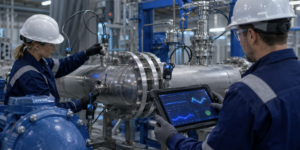
Industrial pressure testing has traditionally depended on pumps, gauges, hoses, handwritten records, and the trained judgment of experienced technicians. Those fundamentals remain important, but information technology is changing how tests are planned, monitored, documented, and evaluated.
Smart sensors, connected equipment, cloud platforms, digital records, and predictive analytics are bringing hydrostatic testing into a new era. Instead of receiving a single pressure reading at a particular moment, technicians can now collect a detailed stream of information throughout the testing cycle. That deeper visibility helps businesses detect abnormal pressure changes, document test conditions, improve consistency, and address potential weaknesses before equipment returns to service.
The result is a more informed approach to protecting pipelines, tanks, pressure vessels, plumbing systems, and other components that must safely contain pressurized liquids. This combination of physical testing and digital intelligence is turning hydrotesting into an increasingly valuable part of modern asset management. 💻
The Essential Purpose of Hydrostatic Testing
Hydrostatic testing evaluates the integrity of equipment by filling it with water or another suitable liquid and applying a specified level of pressure. The test is intended to confirm that the equipment can maintain pressure without leaking, deforming, or displaying other signs of weakness.
A properly performed Hydrotest can help identify leaks, defective connections, deteriorated materials, and structural problems that may be difficult to observe during an ordinary visual inspection. Because liquids are generally far less compressible than gases, hydrostatic methods can offer important safety advantages when pressure testing is appropriate for the component and application.
The principles behind this process are well established. However, the tools used to capture and interpret test results are becoming more sophisticated. The broader history of hydrostatic testing shows how a straightforward pressure-based procedure has developed into an essential inspection method across numerous industries.
Modern IT systems do not replace the physical test. They enhance it by recording more information, helping technicians recognize subtle changes, and creating a traceable record of what happened from the beginning of the test through final depressurization.
Smart Sensors Provide a Clearer View of Every Test
Traditional analog gauges provide valuable information, but they depend on someone being present to observe and record each reading. A smart pressure sensor can collect readings automatically at frequent intervals, producing a continuous digital record of the test.
Additional sensors may measure water temperature, ambient temperature, flow, vibration, equipment movement, or other conditions that could affect the interpretation of results. When these data points are viewed together, technicians gain a more complete picture of how the tested system behaved.
For example, a minor decrease in pressure does not automatically prove that a leak is present. Temperature changes can influence pressure readings, and equipment may respond differently as it settles under load. Digitally recording both pressure and temperature gives technicians better information for distinguishing a genuine integrity concern from a normal environmental effect.
The National Institute of Standards and Technology has highlighted the importance of monitoring, diagnostic, and prognostic technologies in improving the reliability of smart manufacturing systems. The same general principle applies to pressure testing: better measurements support better maintenance decisions.
Sensor accuracy still matters. Smart equipment must be properly selected, installed, calibrated, and maintained. A digital display is not automatically more trustworthy simply because it is electronic. Reliable results continue to depend on sound testing procedures and verified instrumentation.
Real-Time Alerts Help Technicians Respond Faster
One of the most practical benefits of connected hydrotest technology is the ability to establish automatic alerts. Software can be configured to notify technicians when pressure moves outside a defined range, when the rate of pressure change becomes unusual, or when a sensor stops reporting.
These notifications give workers an opportunity to evaluate changing conditions promptly. A technician does not have to wait until the end of the holding period to discover that pressure began declining much earlier. The system can create an alert as soon as the readings meet the chosen criteria.
Remote monitoring may also be useful when a test must be observed from a safe location. Authorized personnel can review readings through a secure control station, tablet, or computer without crowding the immediate testing area.
This does not mean hydrotests should be left unattended or controlled without qualified supervision. Digital alerts are support tools, not substitutes for trained personnel, approved procedures, site controls, and sound judgment. Their value lies in helping the testing team recognize important developments sooner.
Digital Records Strengthen Test Documentation
Paper forms can be misplaced, damaged, or completed inconsistently. Handwritten entries may also be difficult to read, and a short series of recorded measurements cannot capture every pressure change that occurred during a lengthy test.
Digital data logging addresses many of those limitations. A smart hydrotest platform can preserve time-stamped readings, calibration details, equipment identifiers, test limits, technician information, photographs, notes, and electronic approvals in one organized record.
A detailed digital report can show when pressurization began, how rapidly pressure increased, whether the target was reached, how conditions changed during the holding period, and when the system was depressurized. That creates a stronger foundation for internal reviews, customer reports, future maintenance planning, and compliance documentation.
Cloud-based systems can make records easier to locate across multiple facilities, although businesses must establish clear rules for access, retention, backups, and protection. The growing role of the Internet of Things in industrial environments demonstrates how connected devices can collect operational information and support condition monitoring across equipment networks.
Good documentation also improves continuity. If a component is tested again several years later, technicians may be able to compare the new results with its earlier performance instead of evaluating the latest test in isolation.
Analytics Can Reveal Developing Equipment Problems
A single test determines how a component behaved under specified conditions at a particular time. A collection of test records can reveal something broader: how an asset’s behavior is changing.
When pressure, temperature, duration, leakage observations, and repair history are stored in a consistent format, analytics software can search for patterns. It may identify equipment that requires repeated repairs, a class of components with similar weaknesses, or a gradual change in performance over several testing cycles.
This is closely connected to the expanding use of predictive maintenance. According to IBM’s overview of predictive maintenance, operational data and real-time condition monitoring can help organizations identify early warning signs and anticipate when assets are likely to fail.
Hydrotest data is only one part of that picture. Inspection findings, operating pressure, service history, corrosion monitoring, fluid characteristics, environmental exposure, and maintenance records may all be relevant. Combining these sources can help engineers and asset managers prioritize inspections and repairs more effectively.
The objective is not to let an algorithm make an unsupervised pass-or-fail decision. The objective is to provide qualified professionals with more organized evidence. Engineering requirements, applicable codes, manufacturer instructions, and approved test procedures must remain central to the final determination.
Digital Twins Add Context to Physical Test Results
A digital twin is a virtual representation of a physical object, process, or system. In an advanced industrial environment, data from a hydrotest may be incorporated into a digital model of a pipeline, pressure vessel, or facility.
The model can store design information, material specifications, previous repairs, inspection results, sensor readings, and operating history. Engineers can use this combined information to understand where the tested component fits within the larger system.
Research and standards work involving manufacturing digital twins has explored how real-time and historical sensor information can support maintenance planning and help organizations anticipate equipment problems. When applied carefully, this concept can make pressure-test results more useful long after the field work is completed.
A hydrotest report no longer needs to remain an isolated document in a filing cabinet. It can become part of a continuing digital record that follows the asset throughout its service life.
Cybersecurity Must Be Built Into Connected Testing Systems
Connectivity introduces benefits, but it also creates risks. Any testing platform connected to an industrial network may become part of the organization’s broader cybersecurity environment.
Weak passwords, outdated software, excessive permissions, unsecured wireless connections, or exposed control devices can undermine an otherwise capable testing system. Organizations should separate critical operational functions from unnecessary internet exposure, limit access according to job responsibilities, maintain secure backups, and apply software updates through controlled procedures.
The Cybersecurity and Infrastructure Security Agency provides resources for protecting industrial control systems and operational technology. Its guidance is relevant whenever connected sensors, controllers, or remote interfaces interact with industrial processes.
Cybersecurity also protects the integrity of test records. A pressure report has limited value if an organization cannot verify that the readings are authentic, complete, and unchanged. Secure audit trails, controlled user accounts, encrypted communications, and reliable time synchronization can help preserve confidence in the data.
Automation Improves Consistency Without Removing Human Oversight
Modern hydrotest equipment may automate portions of the pressurization, holding, monitoring, and reporting process. Controlled automation can help limit abrupt pressure changes, maintain a planned sequence, and reduce variations between testing teams.
Automated systems can also guide technicians through required steps, preventing the test from advancing until designated checks are completed. This may include confirming equipment identification, verifying calibration status, documenting exclusion zones, or acknowledging that connections have been inspected.
Work involving predictive maintenance and industrial sensor data shows the growing technical interest in using connected measurements to detect developing machine problems. Yet automation must be designed around real operating conditions. Sensors can fail, communications can drop, and software settings can be entered incorrectly.
Qualified personnel must remain capable of recognizing unsafe conditions and stopping the operation. Emergency procedures, pressure-relief provisions, safe work zones, equipment ratings, and physical inspections continue to matter regardless of how advanced the software becomes. Technology works best when it strengthens human decision-making rather than creating blind dependence on a screen. ⚙️
Smarter Testing Can Reduce the Cost of Failure
The direct cost of repairing a leak may be modest compared with the broader consequences of an unexpected failure. Businesses can face damaged equipment, interrupted production, environmental cleanup, delayed projects, emergency labor, lost materials, regulatory attention, and harm to their reputation.
Smart hydrotest technology helps manage that exposure in several ways. It produces more complete test records, makes abnormal changes easier to detect, supports comparisons over time, and helps maintenance teams act before a developing problem becomes a major disruption.
It may also reduce unnecessary work. When asset records are accurate and accessible, managers can plan inspections and maintenance according to documented conditions rather than incomplete information. That does not eliminate scheduled testing or code requirements, but it can improve how labor, replacement parts, and downtime are coordinated.
The financial value comes from more than faster testing. It comes from making each test part of a larger reliability strategy.
Conclusion
Hydrostatic testing remains grounded in a simple and proven principle: apply controlled liquid pressure and evaluate whether the equipment can safely withstand it. Information technology is making that process more visible, traceable, and useful.
Smart sensors can capture pressure and temperature continuously. Connected platforms can issue alerts when readings become abnormal. Digital reports can preserve a detailed testing history, while analytics and digital twins can place those results within the broader condition of an asset. Secure automation can also improve consistency when it is implemented with proper safeguards and professional oversight.
The most important breakthrough is not one sensor, application, or algorithm. It is the ability to turn a temporary field test into lasting operational intelligence. By combining established hydrotesting practices with secure IT systems and qualified human judgment, organizations can identify weaknesses earlier, plan maintenance more effectively, and prevent costly failures before they happen.